TL;DR: It is rough.
First off—and I’m not expert in this—but I want to say that students are not “using AI to write their papers.” Based on my understanding, the Chat-GPTs and Claudes and Geminis now forced into my midst are not the Artificial Intelligence that Turing talked about over 75 years ago. These are “large language models” that are basically doing text prediction in a very sophisticated, expensive way. In my opinion, we really should not be doing free advertising for these companies by falsely inflating their products and saying they meet the definition of “AI.”
Second, I mostly avoid using these tools myself for ethical reasons. Also because I like writing, I like mistakes, and I am already more screen-addicted than I want to be. Frankly, the couple times I tried to use an LLM “for research,” it consistently issued forth fake sources, and that’s embarrassing. I can make mistakes on my own, thank you very much!
As an English professor, I can attest that it’s incredibly difficult now to assess whether or not a student has authentically produced a work of writing unassisted by LLMs without surveilling their process live, in class. So, given the fact that our colleges are still running asynchronous courses, I decided to give one a go over the summer simply so I could see for myself how well I could do it.
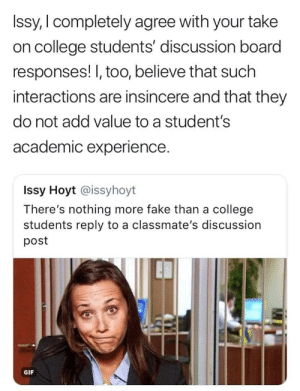
Teaching an online course is rough for me. I rely on my in-person goofiness to entertain students, and I really like getting to know people face-to-face. I also hate working within the constraints of the Learning Management Systems (in our case, BrightSpace). Online learning has its own conventions at this point, and many are worthy of derision (see meme below). I also hadn’t taught online since the pandemic, so reaching into that quiver of tools evoked some gloom for reasons unrelated to the here and now.
I faced the challenge with a question: Could I design assignments and motivate learning in such a way that would preempt student use of LLMs? (I take it as a given at this point that I cannot assess a student’s ability to meet the learning objectives of my courses if they use LLMs to do their assignments.) I viewed this challenge with the sort of enthusiasm I bring to a Sudoku or crossword puzzle: a tepid enthusiasm that can easily turn into frustration and existential self-doubt. In anticipation, I read a bunch of articles on the topic, I consulted with my tech-savvy colleagues, and I spun my pedagogical wheels.
Did I succeed? Hmm. No, I don’t think I was extraordinarily successful at solving the problem posed by teaching asynchronously in the age of LLMs. But I did have a handful of awesome, motivated, intellectually driven students who turned in great work.
What did I do to try and solve this puzzle?
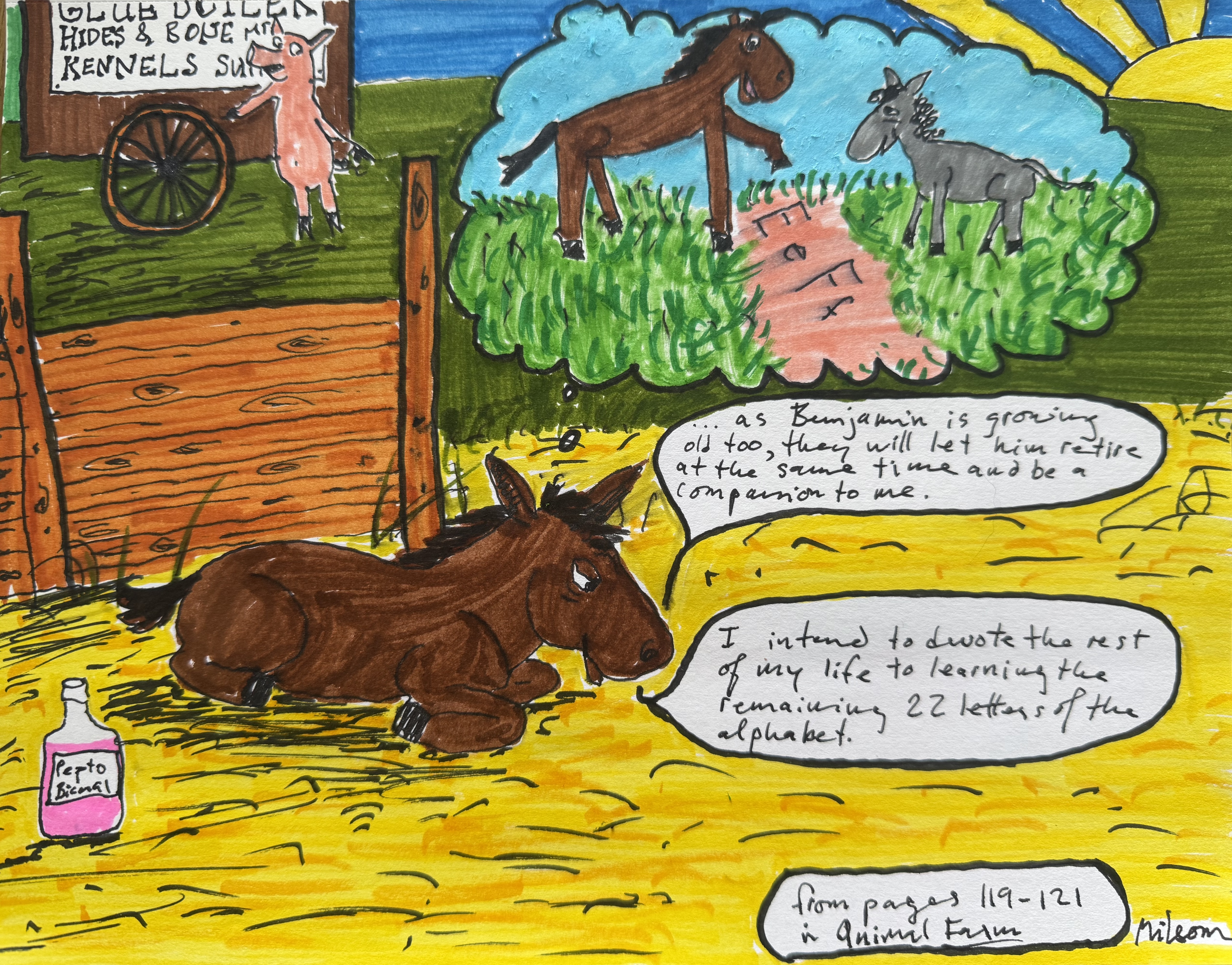
First, I assigned some art projects. I always teach students how to analyze and understand imagery and figurative language, and this lends itself well to illustration: “Illustrate the metaphor” is a great assignment. Getting students to tease apart literal from figurative language, to infer the implied comparisons, and to derive meaning from it all is a really important and fun task. Even just “illustrate a scene” in detail prompts students to examine text carefully and deliberately choose aspects of it to emphasize. Students regularly tell me that they love the chance to just “color” in this way – they can tap into their childhood selves. Students also loved seeing their classmates’ work. I don’t give students a grade based on how “great” they are at drawing, but it’s obvious when students spend time thinking through the details and conveying their interpretation of the language. I value the time that they spend on the assignment, and it’s clear that they do as well. I also do these art assignments myself so they can see what sort of effort I’m looking for, and so they don’t feel like I’m asking them to do something I wouldn’t do myself.
Second, as an experiment, for one discussion board assignment, I required that students recorded themselves talking—unscripted—in response to a prompt. It was truly wonderful to hear all their voices! Remember, this was an asynchronous class, which means you never “meet” live. Only a couple of them had ever scheduled Zoom meetings with me, so this was the first time I’d gotten a “hit” of them as humans with bodies. Many also told me they loved hearing their classmates’ voices.
Third, for a fun “optional” assignment, I told them to take selfies of themselves reading one of the novels I’d assigned. Most participated, and the results were cute. One girl was reading at the hairdresser, under the dryer. One girl was in a cozy nook under a bunk bed. One man was sitting at dinner, reading over some soup. Reading a long novel (some for the first time) can be hard, and creating some sort of feeling of solidarity and community was worth the small effort.
In spite of a few wins, I didn’t solve the puzzle: I find it difficult to design assignments for an online course that meet this new moment. LLM use has to be at the forefront of an instructor’s mind if the credits we issue are to mean anything. Surely we have to be diligent about authenticating student work, but any easy answer to this is too good to be true. And you can’t hang any hope on the idea that tech will defeat tech, given the widely documented failure of AI-detection software to work. So I’m going to have to keep spinning my pedagogical wheels – and teaching in person.
For the first weeks of the summer session, I felt agonized by the choices I had to make: Would I embed hidden, white text into assignments that would trigger absurd responses in the LLM? Would I issue draconian “Fs” and accuse students of LLM use when/if I could reproduce their responses with low-token LLMs myself? Would I give up and just reward low-effort copy-and-paste write-ups since you can’t do much to prevent them?
But by the end of the semester, having gone both ways in response to all of those early choices and coming up short, I did get some positive feedback from the students, particularly about the more unconventional things I tried to have them do. Additionally, a few students had actually read novels for the first time in their lives thanks to the class; a few could now graduate (this being one of the final courses they needed to fulfill some requirement); and a few felt eager to read even more! Knowing this makes me feel as though teaching the class actually had been worth it, in spite of my own sense of fatigue and failure.

